
Modern manufacturing can’t afford to operate at the pace of rigid software cycles. Markets shift overnight. Supply chains fluctuate. Customer expectations evolve faster than ever. And manufacturers relying on outdated MES platforms risk falling behind competitors who can adapt faster.
Throughout our latest blog series, we explored how an elastic MES propels manufacturers forward—not simply through new software, but through a new architectural approach. One that eliminates silos, avoids disruptive rip-and-replace strategies and ensures production continues under real-world conditions.
In this recap, we bring those ideas together into a cohesive roadmap, showing how an elastic foundation moves you from strategy to execution, enabling greater operational agility, built-in resilience and a future-ready path toward autonomous, AI-driven manufacturing.
Building the Foundation
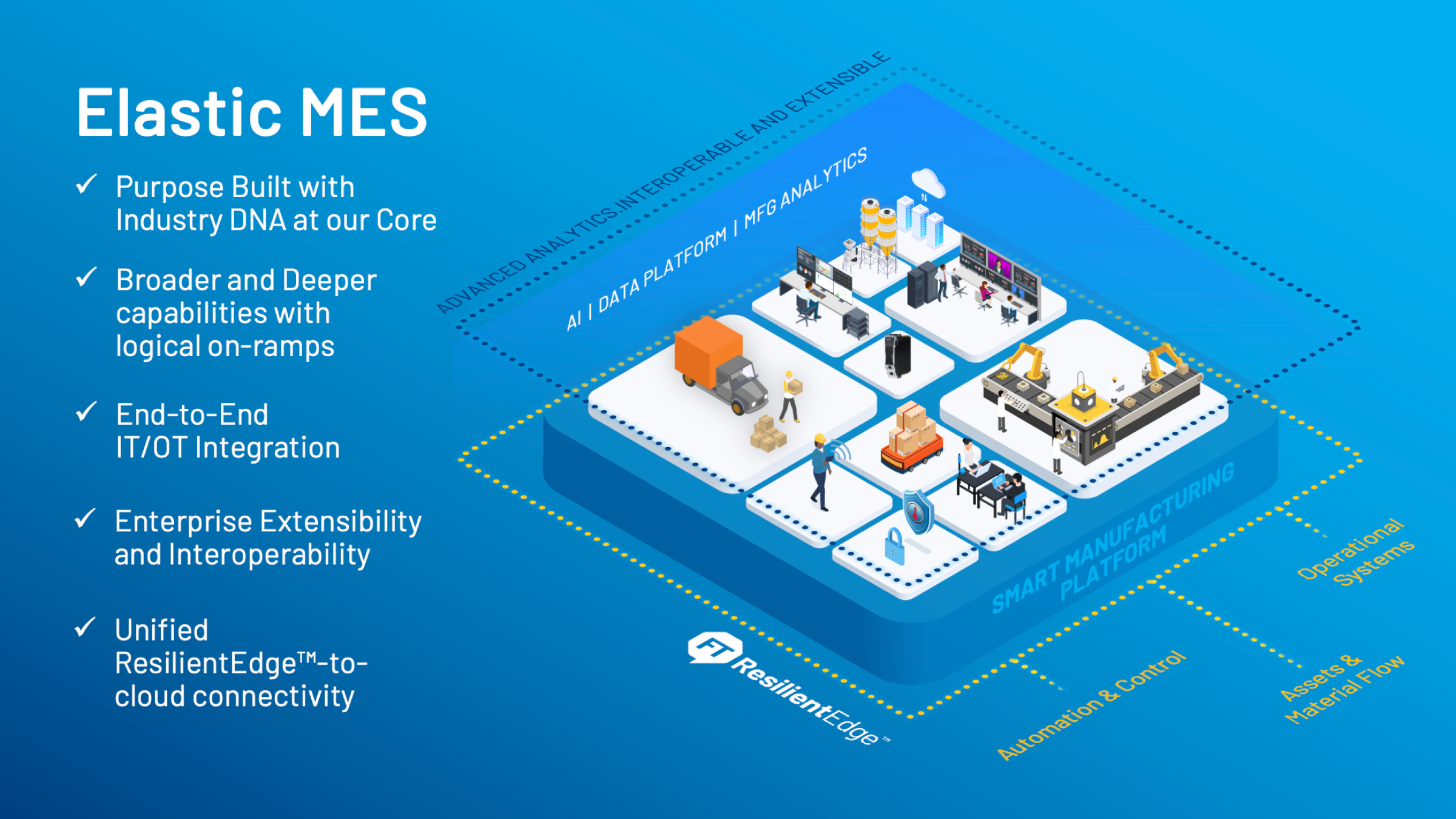
We began with the elastic MES overview, taking a broad look at what an elastic MES truly is, including its comprehensive capabilities and the measurable benefits it delivers to manufacturers. From the start, we positioned elastic MES as more than a deployment model. It represents a shift away from monolithic systems toward modular, adaptive architecture built for change.
At the heart of that architecture is flexibility. Rather than requiring a disruptive system overhaul, an elastic MES enables a “land-and-expand” approach. Manufacturers can deploy capabilities in phases, aligning investment to business priorities while maintaining operational stability. This modular MES implementation model prevents costly rip-and-replace cycles and creates a scalable foundation for long-term growth.
That foundation is further strengthened in purpose-built for manufacturing . Here, we reinforce a critical point: transformation only works when software is designed for the shop floor first. Supporting discrete, process and hybrid operations within a single platform ensures manufacturers don’t outgrow their system as production complexity evolves.
Equally important, this shop-floor-first design works hand-in-hand with modular deployment. Instead of forcing a full system overhaul, an elastic MES allows manufacturers to activate capabilities in phases, reducing risk, preserving capital and accelerating ROI while laying the groundwork for future-proof manufacturing execution.
This is how meaningful transformation begins: with flexibility at the core.
Connecting the Enterprise
With a flexible, modular foundation in place, the next phase of the journey focuses on integration. Because architecture alone doesn’t drive transformation. Connection does.
In unified OT/IT integration, we tackle one of manufacturing’s most persistent challenges: disconnected systems and siloed data. An elastic MES extends the foundation established in the first two blogs by enabling contextual data flow across the enterprise through an industrial data fabric. Data moves with meaning, from the sensor on the line to the supervisor on the floor to leadership in the C-suite.
Building on that, extensible by design demonstrates how integration does not require disruption. Modernization shouldn’t force manufacturers to abandon functioning PLCs or legacy infrastructure. Instead, an elastic MES works alongside existing systems, preserving prior investments while enabling a scalable, cloud-native manufacturing strategy.
By eliminating the need for rip-and-replace overhauls, manufacturers reduce capital strain and implementation risk, all while strengthening the data foundation required for advanced analytics and industrial AI readiness.
If the first phase establishes flexibility, this phase unlocks connectivity. Integration becomes the force multiplier, accelerating transformation rather than slowing it down.
Ensuring Real-World Resilience
Strategy and integration mean little without reliable execution. In resilient edge-to-cloud deployment, we examine how an elastic MES solves a fundamental tension in modern manufacturing: cloud scalability versus on-premises determinism.
Cloud-only systems may struggle to guarantee latency and continuity under all conditions. Traditional on-premises deployments can stall innovation. An elastic MES bridges both worlds.
With edge-to-cloud architecture and disconnected-state capability, production continues even if connectivity drops. High-speed lines maintain deterministic execution. Data synchronizes seamlessly once connections are restored.
This is manufacturing business continuity by design. Not by workaround.
The Path Forward: From Strategy to Action
Taken together, this roadmap defines what modern manufacturing execution must become.
- Start with a flexible, modular foundation that evolves as your business evolves.
- Deploy software purpose-built for manufacturing complexity, not retrofitted from generic enterprise systems.
- Connect OT and IT through contextualized data that flows seamlessly across the enterprise.
- Extend existing infrastructure without disruption or costly rip-and-replace cycles.
- Execute reliably through resilient edge-to-cloud architecture that protects production in real-world conditions.
This is how manufacturers move confidently along the autonomous operations journey, progressing from visibility to optimization to AI-driven insight.
The impact is measurable:
- Greater operational agility to scale production with market demand
- Cost savings by leveraging existing PLCs and legacy assets
- Expanded shop floor visibility across lines, plants and global sites
- A contextualized data foundation built for advanced analytics and industrial AI
- A practical, sustainable path to digital transformation in manufacturing
An elastic MES does more than modernize technology. It reshapes how manufacturing adapts, competes and grows. It creates a future-proof execution strategy built for continuous change.
Ready to Build Your Elastic Foundation?
If your organization is ready to move beyond siloed systems and rigid infrastructure cycles, the next step is implementation.
Ready to build your elastic foundation? Contact our experts for a personalized demo of how Plex can modernize your shop floor and accelerate your manufacturing digital transformation.
The future of manufacturing isn’t rigid.
It’s connected. It’s resilient.
It’s elastic.
Related Articles